
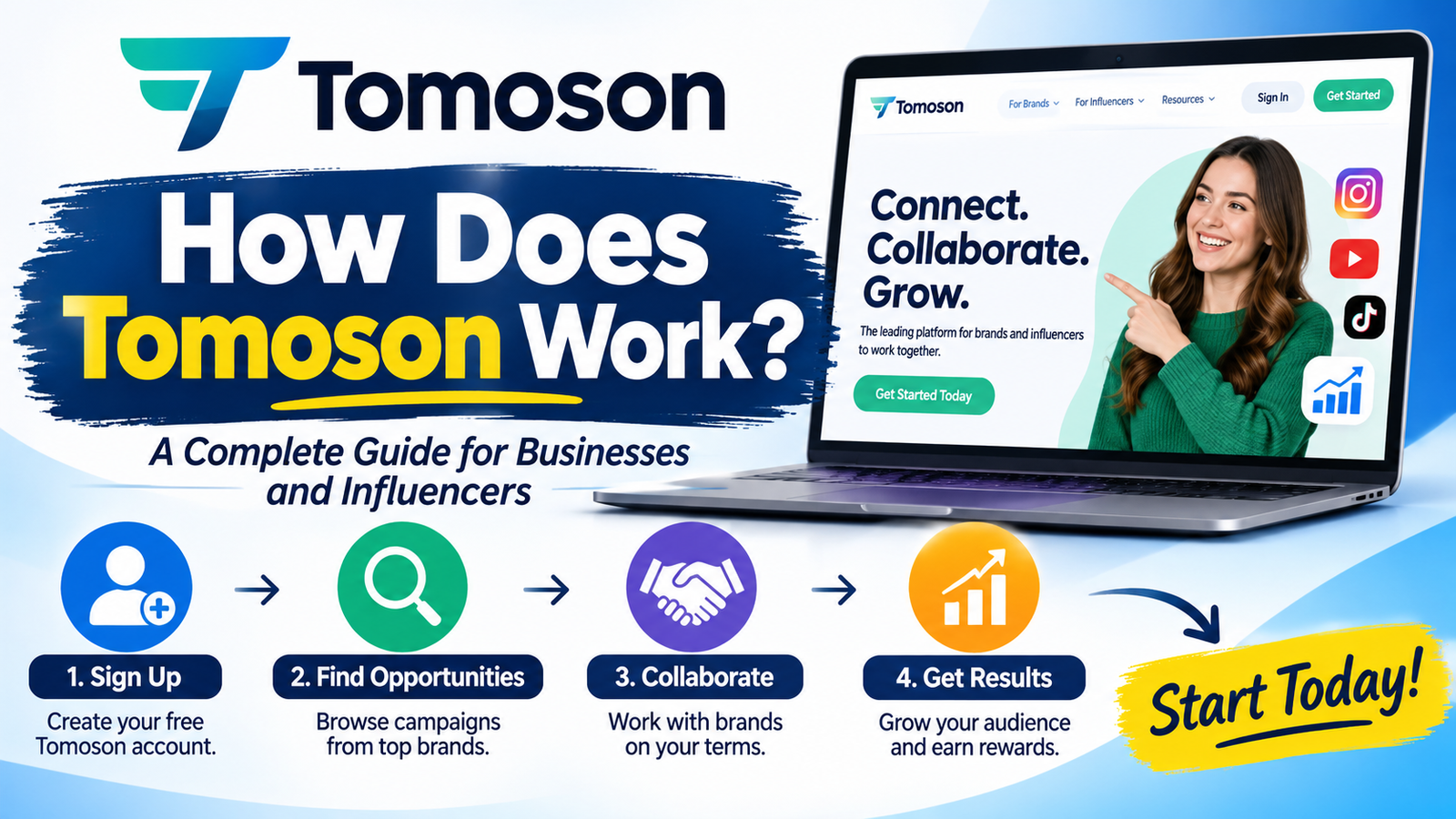
How Does Tomoson Work?
Tomoson is known as an influencer marketing and product promotion marketplace. Its original business model connects companies with bloggers, social media creators, and product reviewers.
The basic idea is straightforward: a business offers a promotional opportunity, creators apply, and selected participants receive a product or other agreed compensation in exchange for completing specific promotional tasks.
For example, a company launching a kitchen appliance might use this type of marketplace to find food bloggers and home-lifestyle creators. The company provides the product, explains its campaign requirements, and selects suitable applicants. Creators then test the appliance and produce content according to the agreed terms.
Tomoson’s published documentation describes several campaign activities, including:
- Product testing and honest reviews.
- Blog articles and sponsored content.
- Social media promotions.
- Product photographs and videos.
- Tutorials and demonstrations.
- Product launches and promotional campaigns.
The platform’s official documentation also describes separate responsibilities for brands and influencers. However, its published historical workflow should not automatically be interpreted as proof that every feature is currently operational.
How Does Tomoson Work for Brands?
Businesses use Tomoson’s documented marketplace model to organize promotional campaigns and find creators who match their products and target audiences.
The process traditionally involves several stages.
1. Create a Brand Account
A business starts by registering and preparing information about its company and products.
Useful information includes:
- Brand or business name.
- Product descriptions.
- Product images.
- Website or online store.
- Target audience.
- Product category.
- Campaign objectives.
Providing accurate information helps potential collaborators understand the product and decide whether it suits their audience.
2. Create a Marketing Campaign
After preparing its account, a business can create a campaign describing the promotional opportunity.
A campaign brief should explain what the business wants to achieve and what creators must deliver.
For example, a skincare company might request product testing and an honest blog review. A technology business might prefer an unboxing video or a product demonstration.
Campaign requirements can include:
- Preferred creator niches.
- Minimum audience or website traffic requirements.
- Product information.
- Required promotional activities.
- Expected completion time.
- Product delivery or coupon arrangements.
Tomoson’s brand FAQ describes campaign prerequisites that help businesses identify suitable applicants.
3. Review Influencer Applications
Once a campaign becomes available, interested creators can apply.
Businesses can evaluate applicants using information such as their niche, audience size, social profiles, and website statistics.
Tomoson’s documentation describes a process in which creators meeting specified requirements may be preapproved, followed by the brand’s final selection.
This gives businesses an opportunity to consider audience relevance instead of choosing creators based only on follower numbers.
4. Provide Products or Promotional Offers
After selecting creators, the business arranges the agreed product or promotional benefit.
According to Tomoson’s official brand FAQ, businesses may provide products at no charge or upload valid coupon codes, depending on the campaign arrangement.
The brand is responsible for supplying the product as described in its campaign. It should also communicate any shipping delays or problems that could affect the creator’s completion deadline.
5. Review Completed Campaign Tasks
After receiving the product, creators complete the agreed activities and submit links to their work.
The business can then check whether the submitted content meets the campaign requirements.
Tomoson’s brand documentation explains that completed campaign tasks and review links can be accessed through the campaign dashboard.
A business should check that the content is genuine, relevant, and consistent with the original agreement.
How Does Tomoson Work for Influencers and Bloggers?
Tomoson is also designed to help content creators discover promotional opportunities.
Bloggers and influencers can use its documented marketplace model to find businesses interested in product testing, reviews, and promotional content.
The process generally follows these steps.
1. Register as an Influencer
Creators begin by preparing an influencer profile.
A useful profile should include:
- Blog or website information.
- Social media accounts.
- Main content categories.
- Audience information.
- Relevant publishing experience.
- Previous collaboration examples.
Accurate profile information makes it easier for businesses to evaluate whether a creator is suitable for a campaign.
2. Find Relevant Campaigns
Creators can explore promotional opportunities that match their interests and publishing categories.
For example:
| Creator category | Relevant campaign examples |
|---|---|
| Technology bloggers | Gadgets, accessories, and software |
| Beauty influencers | Skincare and cosmetics |
| Food bloggers | Kitchen appliances and food products |
| Parenting bloggers | Family and children’s products |
| Fitness creators | Sports equipment and fitness accessories |
| Lifestyle influencers | Home products and everyday essentials |
Choosing relevant opportunities is important. A creator who regularly publishes technology content may not be the right candidate for a fashion campaign.
3. Apply for Suitable Opportunities
Creators review the campaign instructions before applying.
They should understand the product, expected deliverables, deadlines, and compensation arrangements.
Tomoson’s influencer FAQ explains that brands establish eligibility requirements and make the final selection.
Applying selectively is more useful than accepting every available opportunity. Creators should consider whether they can genuinely test the product and produce original content.
4. Receive and Test the Product
When selected, the creator receives the product or coupon arrangement specified in the campaign.
Tomoson’s documentation states that products are intended for testing and honest feedback. It also prohibits selling products received for review purposes.
Creators should examine the product carefully before publishing their opinions. If something does not work as expected, they should describe their experience honestly.
5. Publish Content and Submit Proof
After testing the product, the creator completes the required activity.
Depending on the agreement, this could involve:
- Writing a detailed blog review.
- Publishing a social media post.
- Creating an unboxing video.
- Sharing product photographs.
- Producing a tutorial.
- Submitting feedback through an agreed channel.
Creators then submit valid links to their published work for verification.
Tomoson’s influencer FAQ emphasizes original content, valid links, and completing campaign tasks within the agreed timeframe.
How Much Does Tomoson Cost?
Tomoson’s pricing structure is different for businesses and influencers.
According to its published FAQs, influencers can use the platform without paying a registration or participation fee. Brands, however, are subject to a monthly subscription fee after the free trial period.
The official brand FAQ also explains that businesses should consider several expenses when preparing their marketing budgets:
| Expense | Description |
|---|---|
| Platform subscription | Monthly fee for using the software |
| Product cost | Value of products supplied to creators |
| Shipping | Delivery costs for physical products |
| Influencer compensation | Payment for agreed promotional work |
| Campaign management | Time spent reviewing applications and deliverables |
The official documentation describes a free trial limited to one per brand and a maximum of 10 campaigns. However, these are published terms, not a guarantee that the same trial is currently available to new accounts.
Is Tomoson Free for Influencers?
Yes. Tomoson’s published influencer FAQ states that creators can use the service for free.
However, receiving a free product does not always mean that the entire campaign is cost-free. Some opportunities involve discounted products rather than completely free samples.
Creators should carefully examine each campaign before applying. They should check whether shipping charges, purchases, content requirements, or other conditions apply.
Does Tomoson Charge Brands?
Yes. Its published brand FAQ describes a monthly subscription fee after the free trial.
The amount should be checked on the current pricing page before registration. Businesses should also calculate product, shipping, and creator compensation expenses separately.
Because pricing and platform availability can change, relying on older third-party pricing estimates is not advisable.
What Types of Campaigns Can You Run on Tomoson?
Tomoson’s published documentation describes several promotional activities. The exact suitability of each format depends on the campaign and the current platform capabilities.
Product Review Campaigns
Product review campaigns allow businesses to send products to selected creators for testing and feedback.
For example, a company selling wireless headphones might work with technology bloggers. The bloggers test sound quality, comfort, battery performance, and other relevant features before publishing honest feedback.
An important point is that product reviews should reflect genuine experiences. Brands should not demand positive ratings in exchange for free products.
Sponsored Blog Posts
Businesses can collaborate with bloggers to produce articles about their products or services.
These articles may explain product features, demonstrate practical uses, or share a creator’s experience.
Sponsored content should be clearly identified. Readers deserve to know when a commercial relationship influences the content.
Social Media Promotions
Social media campaigns help brands reach audiences through platforms such as Instagram, YouTube, and other creator channels.
A creator might publish:
- An Instagram product demonstration.
- A YouTube unboxing video.
- A short product tutorial.
- A Facebook promotional post.
- A series of product photographs.
The business should define the expected format, publication date, and disclosure requirements before the collaboration begins.
Product Photography and Videos
Some businesses need original visual assets rather than written reviews.
For example, a home decoration company might collaborate with lifestyle creators to produce photographs showing its products in real-world settings.
These assets can potentially support a brand’s wider marketing activities, subject to the creator’s content licensing and usage agreement.
Product Launch Campaigns
Businesses preparing to launch new products can use influencer collaborations to introduce their offerings to relevant audiences.
A coordinated campaign might involve several creators publishing content around the launch date.
However, successful launches require realistic schedules, reliable product delivery, and clear communication.
What Are the Main Benefits of Tomoson?
Tomoson’s documented marketplace model offers several potential advantages for brands and content creators.
1. Access to Relevant Creators
Businesses can use campaign requirements to identify creators working in specific niches.
This can make influencer discovery more organized than contacting unrelated accounts individually.
2. Product Testing and Feedback
Brands can receive feedback from people who actually test their products.
This information may help businesses identify product strengths, weaknesses, and possible improvements.
3. Opportunities for Smaller Creators
The platform’s model is relevant to bloggers and micro-influencers who may not have access to large brand partnerships.
Creators with focused audiences can potentially find opportunities that match their interests and publishing experience.
4. Organized Campaign Management
Tomoson’s official documentation describes application reviews, campaign messaging, task verification, and dashboard-based tracking.
These functions can help businesses organize collaborations in one place.
5. Different Content Opportunities
Brands can seek different types of promotional content, including written reviews, videos, photographs, and social media posts.
This flexibility can help businesses test different content formats.
What Are the Disadvantages and Limitations of Tomoson?
Although the marketplace model has advantages, users should consider several limitations.
1. Product and Shipping Expenses
A free product is not necessarily free for the business providing it.
Companies must consider manufacturing costs, inventory, packaging, and international delivery where applicable.
2. No Guarantee of Positive Reviews
Tomoson’s published policies emphasize honest product feedback.
A business should not expect every creator to publish a positive opinion. Negative feedback may reveal issues that require attention.
3. Creator Selection Requires Research
A large audience does not automatically mean a creator is suitable.
Brands should evaluate audience relevance, engagement quality, publishing history, and content standards.
4. Results Depend on Campaign Quality
A poorly written campaign brief can create confusion.
Unclear deadlines, unrealistic expectations, and incomplete product information may lead to disappointing results.
5. Current Platform Availability Needs Verification
One important limitation deserves special attention.
Although Tomoson’s official FAQ and marketing pages remain accessible, their presence does not independently confirm that new users can currently register, launch campaigns, or apply for opportunities.
Some recent reports have raised questions about the availability of its original marketplace and registration process. Therefore, users should verify the live registration and campaign functions before purchasing a subscription or relying on the platform for business operations.
How to Measure the Success of a Tomoson Campaign
Running a campaign is only one part of influencer marketing. Businesses also need to understand whether their investment produces meaningful results.
Although Tomoson’s published materials describe campaign management and task verification, brands should use additional measurement methods to evaluate business performance.
Important metrics include:
| Metric | What it measures |
|---|---|
| Reach | Number of people potentially exposed to content |
| Impressions | Number of times content is displayed |
| Engagement rate | Audience interactions relative to reach or followers |
| Website clicks | Visitors arriving through campaign links |
| Conversion rate | Percentage of visitors completing a desired action |
| Cost per acquisition | Marketing cost for each acquired customer |
| Content quality | Usefulness and relevance of creator-produced content |
Use Trackable Campaign Links
Brands can create unique URLs using UTM parameters to identify traffic generated by individual creators.
For example, a business could provide different tracking links to five influencers. Website analytics can then help identify which links generate the most visitors and conversions.
Monitor Discount Code Performance
Unique promotional codes can help businesses understand which creators generate purchases.
However, discount-code usage should not be treated as the only measure of success. Some customers may see an influencer’s content and purchase later without using the code.
Evaluate Content Quality
Not every successful influencer campaign produces immediate sales.
A detailed product tutorial may provide long-term value by helping customers understand a product. High-quality photographs and videos may also support future marketing activities when the brand has permission to reuse them.
Businesses should evaluate both measurable sales results and the wider value of the content.
Important Rules for Honest Reviews and Sponsored Content
Product review campaigns involve commercial relationships that creators should communicate transparently.
When a creator receives money, free products, discounts, or other benefits in exchange for an endorsement, disclosure requirements may apply.
The US Federal Trade Commission (FTC) explains that material connections between advertisers and endorsers should be disclosed clearly. This includes situations where a blogger receives a free product with the expectation of promoting it.
Practical disclosure examples include:
- “This product was provided by the brand for review.”
- “This post contains sponsored content.”
- “I received this product for free in exchange for my honest feedback.”
Creators should also follow the advertising and disclosure requirements applicable to their own countries and publishing platforms.
Can Brands Require Positive Reviews?
No. Brands should not demand positive opinions in exchange for products or compensation.
Tomoson’s published FAQ explicitly supports honest product reviews, including negative feedback. Its influencer policy also identifies copied content and reviews that do not demonstrate actual product testing as invalid tasks.
Does Tomoson Help With SEO Backlinks?
Product campaigns can generate online mentions and references to a business. However, brands should not treat influencer campaigns as a guaranteed link-building strategy.
Google’s documentation recommends using rel="sponsored" for links that are advertisements or paid placements. The nofollow attribute remains acceptable for qualifying these links. Google for Developers
A brand can request that creators include a relevant product or website link where appropriate, but it should not make an unqualified SEO backlink a condition of a paid endorsement.
The primary objective should be useful content, genuine recommendations, and audience engagement rather than manipulating search rankings.
Is Tomoson Still Working in 2026?
This is an important question for anyone considering joining the platform.
Tomoson’s official website still contains brand FAQs, influencer FAQs, pricing information, and articles describing its original influencer marketplace. However, its current homepage presents itself as a digital insights and publishing resource rather than clearly demonstrating an active campaign marketplace.
Consequently, there is a difference between understanding how Tomoson’s original system worked and confirming whether someone can use that system today.
Before paying for a subscription or planning a campaign, check the following:
- Whether new brand accounts can be registered.
- Whether influencer registration is available.
- Whether current campaigns can be viewed and applied for.
- Whether the brand dashboard is accessible.
- Whether the published pricing and payment terms are current.
- Whether customer support can confirm that campaign management is operational.
Do not assume that an accessible FAQ or an old campaign description means the marketplace is fully functional.
Our assessment: Tomoson’s documented model is understandable and useful as an example of product-seeding influencer marketing. However, its current marketplace availability should be independently confirmed before making a financial commitment.
Tips for Getting Better Results From Influencer Marketing
Whether using Tomoson or another influencer marketing service, a few practical principles can improve campaign quality.
Choose niche-relevant creators. A smaller creator with a relevant audience may be more useful than someone with many unrelated followers.
Write clear campaign briefs. Explain the product, deliverables, deadlines, compensation, and disclosure requirements before approving participants.
Allow enough testing time. Creators need reasonable time to receive, understand, and evaluate products.
Avoid demanding positive feedback. Honest reviews help maintain audience trust and provide more meaningful product feedback.
Track measurable results. Use campaign-specific links, analytics, and discount codes to evaluate performance.
Build long-term relationships. Successful collaborations can develop into repeat partnerships rather than remaining one-time promotional activities.
Frequently Asked Questions About Tomoson
1. What is Tomoson used for?
Tomoson is known for its influencer marketing marketplace model. It connects businesses with bloggers and social media creators for product reviews, promotional content, product testing, and other marketing activities. Its current marketplace availability should be verified before joining.
2. Is Tomoson free for influencers?
According to Tomoson’s published influencer FAQ, joining as an influencer is free. However, creators should review individual campaign conditions to understand product costs, shipping arrangements, and other requirements.
3. How do brands find influencers on Tomoson?
The documented process allows brands to create campaigns and establish eligibility requirements. Influencers apply based on their niches and audience information, while businesses review applications and select suitable participants.
4. Do influencers receive free products from Tomoson?
Many campaigns described in Tomoson’s FAQ offer products at no charge. Some opportunities provide products at discounted prices instead. Creators should read the campaign conditions before accepting an offer.
5. Does Tomoson guarantee positive product reviews?
No. Tomoson’s published policies support honest and unbiased feedback. Creators are expected to describe their actual experiences rather than publish predetermined positive opinions.
6. Is Tomoson currently available?
Tomoson’s website and historical platform documentation remain accessible, but this does not establish that its original campaign marketplace is fully operational. Prospective users should confirm registration, campaign access, and payment functionality directly before committing.
Conclusion
Tomoson is known for connecting businesses with influencers through product-focused marketing campaigns. Its original model allows brands to create promotional opportunities, review creator applications, provide products, and evaluate completed content.
For influencers, the documented system offers opportunities to discover product testing and promotional collaborations. For businesses, it provides a structured approach to creator selection, product feedback, and campaign organization.
However, understanding how Tomoson traditionally worked is different from confirming whether its original marketplace is currently available. Anyone considering the service should verify its registration process, campaign features, and pricing before investing.
The broader lesson is that successful influencer marketing depends on relevant creators, honest product experiences, clear agreements, transparent disclosures, and measurable objectives. These principles remain important regardless of which platform a business chooses.